
How to Build a Modern SEO Framework and Its Seven Layers for Long-Term Results
Are your website rankings improving, but your brand is still missing from AI-generated answers, recommendations, and online discussions? Traditional SEO alone is no longer enough to build a strong digital presence. Businesses need a modern SEO framework and a broader approach that helps them become visible, credible, and recognizable across multiple search platforms.
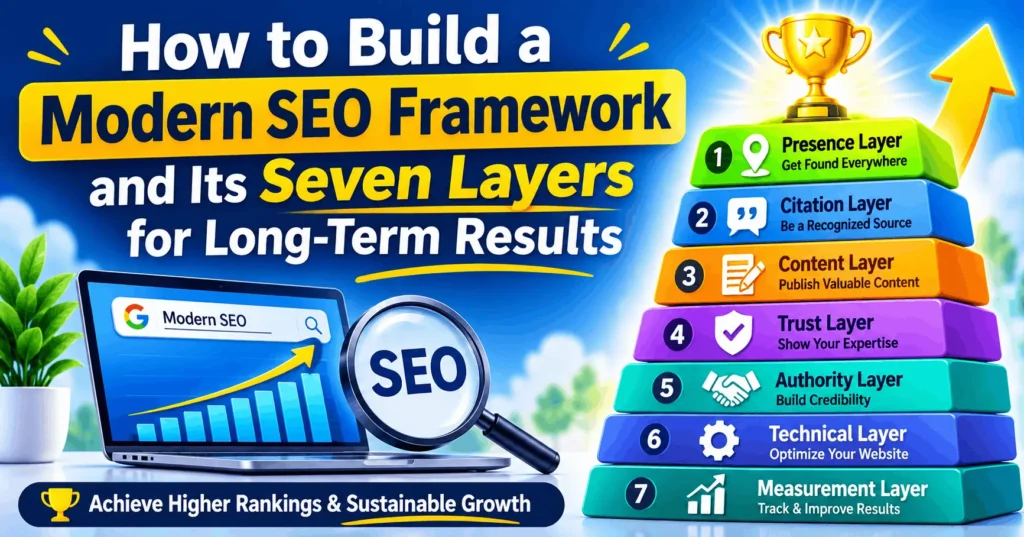
A Modern SEO Framework brings together search visibility, AI citations, valuable content, brand trust, authority, technical optimization, and performance measurement. Instead of focusing only on Google rankings, this approach helps businesses build a recognizable online presence that can deliver sustainable results.
Why Does Modern SEO Matter in 2026?
Search behavior is changing. People still use traditional search engines, but they increasingly explore information through AI-powered platforms, voice assistants, video content, and online communities.
Google reported in 2026 that AI Overviews had more than 2.5 billion monthly active users. This demonstrates the growing importance of understanding how brands appear in AI-powered search experiences.
A successful Modern SEO strategy must therefore focus on three important objectives:
- Visibility: Make your business discoverable wherever potential customers search.
- Credibility: Build trust through useful information, genuine expertise, and reliable mentions.
- Recognition: Help search engines and AI systems understand your brand, services, and expertise.
Here are the seven essential layers that bring these objectives together.
The Seven Layers of a Modern SEO Framework
1. Presence Layer: Get Found Where Your Customers Search
The Presence Layer focuses on making your brand visible across platforms where your target audience discovers information.
Your business should establish a consistent presence on:
- Google Search and Bing.
- Google AI Overviews and AI Mode.
- YouTube and other video search platforms.
- ChatGPT, Perplexity, Gemini, and Claude.
- LinkedIn, Reddit, and relevant industry forums.
- Voice assistants and emerging AI-powered tools.
How to implement it: Create optimized website pages, publish helpful videos, participate in relevant communities, and maintain complete business profiles. Understand which platforms your audience actually uses instead of trying to appear everywhere without a clear purpose.
2. Citation Layer: Make Your Brand a Recognized Source
Being visible is important, but getting mentioned or cited as a reliable source can strengthen brand recognition.
The Citation Layer focuses on how AI platforms and search engines reference your business.
Important activities include:
- Getting your brand mentioned in relevant AI-generated answers.
- Earning inclusion in Google AI Overviews when appropriate.
- Building relevant discussions across indexed platforms.
- Getting your website URLs cited by platforms such as Perplexity and ChatGPT.
- Appearing in relevant comparison and buying recommendations.
- Developing accurate brand information that supports entity recognition.
How to implement it: Publish original research, detailed guides, expert explanations, and helpful resources that other websites and platforms have a reason to reference. Monitor brand mentions and citations regularly.
3. Content Layer: Publish Information Worth Referencing
Content remains one of the strongest foundations of SEO. However, publishing more articles does not automatically create better rankings or AI visibility.
The goal is to create content that answers questions clearly and provides something valuable beyond information already available online.
Follow these practices:
- Answer the main question early in the article.
- Include statistics and facts supported by verifiable sources.
- Add original research, examples, and practical experience.
- Give every page one clear primary topic and search intent.
- Review and update outdated information regularly.
How to implement it: Start with keyword and audience research. Organize content using descriptive H2 and H3 headings, explain complicated topics in simple language, and include examples that help readers take action.
4. Trust Layer: Demonstrate Experience and Expertise
Trust is essential when customers decide whether to believe your business or follow its recommendations.
The Trust Layer focuses on demonstrating Experience, Expertise, Authoritativeness, and Trustworthiness (E-E-A-T).
Build trust through:
- Clear author names and verifiable professional credentials.
- Consistent brand information across platforms.
- Relevant Article, Person, and Organization structured data.
- Genuine mentions from trusted third-party websites.
- Transparent contact information and business details.
- Accurate, well-researched, and regularly reviewed content.
How to implement it: Add author biographies, link to credible references, explain your expertise, and ensure that your website communicates who is responsible for its content.
5. Authority Layer: Build Credibility Beyond Your Website
Website authority is not built through backlinks alone. Your brand also needs recognition within its industry and relevant online communities.
Important authority-building activities include:
- Earning backlinks from relevant, trusted publications.
- Securing quality business and industry directory listings.
- Participating genuinely in relevant online communities.
- Building brand mentions across Reddit, forums, and review platforms.
- Publishing original research that other authoritative sources may reference.
How to implement it: Develop relationships with industry publishers, contribute useful insights to relevant discussions, and create resources worth sharing. Prioritize relevance and editorial quality over the number of backlinks.
6. Technical Layer: Make Your Website Accessible and Understandable
Even excellent content can struggle to perform when search engines cannot properly crawl, render, or understand a website.
The Technical Layer ensures your content is accessible to search engines and eligible AI systems.
Focus on these areas:
- Review robots.txt and crawler access policies for relevant AI bots, such as GPTBot, PerplexityBot, and ClaudeBot.
- Use reliable rendering so important page content is available to crawlers.
- Implement semantic HTML with a logical H1, H2, and H3 hierarchy.
- Add appropriate Article, Organization, Person, and other relevant structured data.
- Maintain XML sitemaps, internal links, mobile usability, and page performance.
You may also consider an llms.txt file as an experimental way to organize important website resources, but it is not a confirmed Google ranking requirement or a guaranteed route to AI citations.
How to implement it: Audit your website regularly using Google Search Console, PageSpeed Insights, and crawling tools such as Screaming Frog.
7. Measurement Layer: Track What Actually Matters
The final layer connects all your SEO activities with measurable business outcomes.
Traditional rankings and organic traffic remain important, but a broader framework should also evaluate brand visibility and AI search performance.
Track these indicators:
- AI citation rate across ChatGPT, Perplexity, Gemini, and Google AI Overviews.
- Brand visibility compared with industry competitors.
- Brand sentiment across relevant online platforms.
- Referral traffic and conversions from different sources.
- Organic impressions, clicks, keyword rankings, and conversions.
- Visibility across a consistent set of target search queries.
How to implement it: Establish a monthly reporting process. Record your starting performance, monitor changes, identify weak areas, and adjust your strategy based on measurable results.
How Does the Modern SEO Framework Work in Practice?
Consider a hypothetical digital marketing agency that receives organic traffic but rarely appears in AI-generated recommendations.
Instead of focusing exclusively on backlinks and keyword rankings, the agency implements all seven layers.
It improves its Google and Bing presence, publishes original industry guides, develops expert author profiles, earns relevant industry mentions, improves website accessibility, and tracks AI citations alongside organic conversions.
After six months, the agency compares its performance with the original baseline to identify improvements in visibility, qualified traffic, brand mentions, and conversions.
The results will depend on competition, execution, and market conditions. The important lesson is that sustainable SEO growth requires multiple connected activities rather than one isolated tactic.
Conclusion: Build All Seven Layers for Long-Term SEO Growth
A successful Modern SEO strategy is about more than achieving higher Google rankings. It requires a complete system that connects presence, citations, content, trust, authority, technical performance, and measurement.
Start by auditing your website against these seven layers. Identify your weakest area, create an improvement plan, and monitor your progress every month.
Looking to strengthen your online visibility and attract more qualified customers? Digital Media Clicks helps businesses turn modern SEO strategies into sustainable digital growth.
Frequently Asked Questions
1. What is a Modern SEO Framework?
A Modern SEO Framework is a structured approach to improving website visibility, brand credibility, search rankings, and AI-powered search presence through connected SEO activities.
2. What are the seven layers of Modern SEO?
The seven layers are Presence, Citation, Content, Trust, Authority, Technical, and Measurement. Each layer supports a different part of long-term search visibility and brand growth.
3. How is Modern SEO different from traditional SEO?
Traditional SEO often emphasizes keyword rankings, backlinks, and organic traffic. Modern SEO includes these fundamentals while also considering AI citations, brand mentions, entity recognition, and visibility across multiple platforms.
4. How can businesses improve their visibility in AI search results?
Businesses can improve their eligibility for AI search visibility by publishing original and useful content, maintaining accessible websites, demonstrating expertise, earning relevant mentions, and following established SEO best practices. However, citations and placements cannot be guaranteed.
5. How long does it take to see results from Modern SEO?
Results depend on website authority, competition, content quality, technical health, and implementation. Some improvements may appear within weeks, while meaningful organic growth and brand recognition often require several months of consistent work.