
Local SEO 2026: How to Optimize for Voice Search and LLM-Powered Local Answers
Imagine a customer saying:
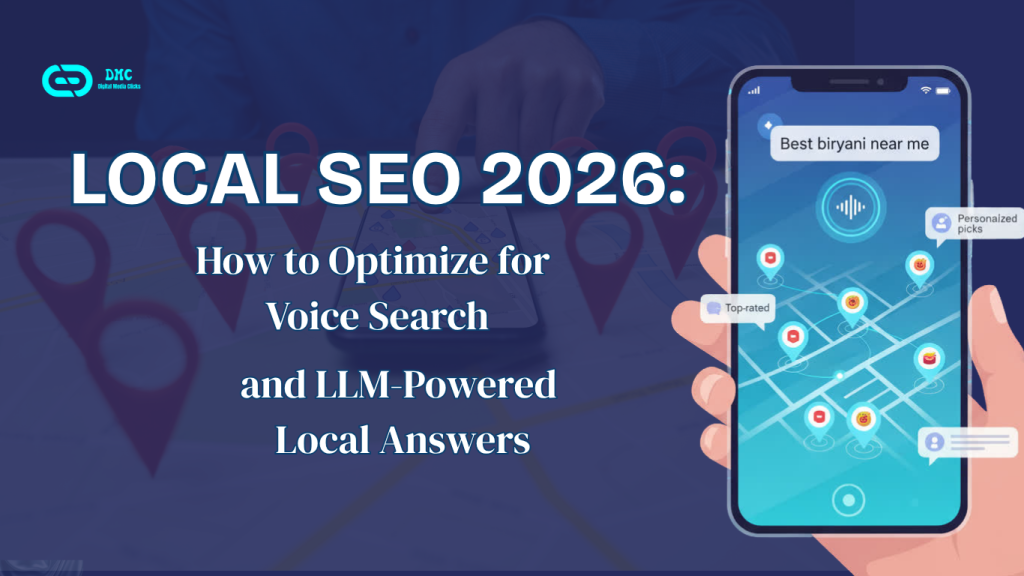
“Hey Google, Lahore mein sabse best biryani place kaunsa hai jo abhi open hai?”
Instead of seeing a Google Map pack, they now get a spoken, AI-generated answer based on verified business data, reviews, and proximity. This is not the future — it’s 2026’s local search reality.
With Google’s Search Generative Experience (SGE), OpenAI’s ChatGPT local plugins, and Apple’s voice-based AI integrations, the way people discover nearby businesses is being redefined. Local SEO is no longer about ranking on page one — it’s about being the source AI trusts enough to recommend.
In this post, you’ll learn exactly how to optimize your business for voice search and LLM-powered local results — and ensure your brand is visible in every AI-driven local interaction.
Why Local SEO Matters More Than Ever in 2026
By 2026, over 60% of all local searches (Local SEO) are conducted via voice or conversational AI interfaces. (Source: BrightLocal, 2025).
Meanwhile, large language models (LLMs) — like Gemini, ChatGPT, and Perplexity — are pulling real-time local data from verified sources such as Google Business Profiles, Yelp, and schema-enabled websites to create rich, contextual answers.
That means:
- The old “10 blue links” SEO strategy is obsolete.
- AI-summarized local answers are the new digital storefront.
- Businesses must focus on semantic, entity-based optimization — not just keywords.
If your business information, reputation, or content isn’t AI-readable, you’re invisible in this new landscape.
4–6 Practical Strategies to Dominate Voice and LLM Local Search
1. Optimize for Conversational Queries and Intent
Voice searches are longer, more natural, and question-based — e.g.,
“Where can I get affordable dog grooming near Clifton that’s open on Sundays?”
Action Steps:
- Use question-style headings (“Where can you find…”, “How to choose…”) throughout your content.
- Include long-tail conversational phrases in your blog posts, FAQs, and product pages.
- Analyze “People Also Ask” and voice transcripts from tools like AnswerThePublic and Semrush Keyword Magic.
Pro Tip: Rephrase your website copy to sound human and conversational — write like your customer speaks.
2. Strengthen Your Google Business Profile (GBP) for AI
LLMs and voice assistants rely heavily on Google Business Profile data to verify local relevance.
Action Steps:
- Keep your NAP (Name, Address, Phone) consistent across all platforms.
- Add high-resolution images, categories, and updated business hours.
- Post weekly updates with localized keywords and offers.
- Collect and respond to reviews using natural, keyword-rich language.
Example:
Instead of replying, “Thank you,” say,
“Thanks for choosing our Clifton branch for your haircut — we’re glad you loved the experience!”
3. Use Structured Data and Local Schema Markup
Structured data is how search engines and LLMs understand your business context.
Action Steps:
- Add LocalBusiness, FAQ, and Review schema to your pages.
- Use JSON-LD format for better indexing by AI crawlers.
- Include geo-coordinates, opening hours, and sameAs links to social profiles.
- Test with Google’s Rich Results Test and Schema.org Validator.
This helps your business appear in AI summaries, knowledge panels, and voice snippets.
4. Create LLM-Friendly, Hyper-Local Content
AI prefers contextually rich, locally relevant content over keyword stuffing.
Action Steps:
- Publish neighborhood guides, “best of” lists, and local event recaps.
- Mention local landmarks and partner businesses (entities that AIs connect).
- Incorporate first-hand insights or stories that show real expertise (E-E-A-T).
- Use visuals — infographics, short videos, and local maps.
Example:
Instead of a generic title like “Best Coffee Shops,” write:
“Top 5 Artisan Coffee Shops in Downtown Karachi (Reviewed by Locals).”
5. Optimize for Multi-Device Voice Ecosystems
Your customers are asking local questions through:
- Smart speakers (Alexa, Google Home)
- Mobile assistants (Siri, Gemini)
- Cars and wearables
Action Steps:
- Ensure your website loads in under 2 seconds on mobile.
- Implement HTTPS and mobile-first design.
- Add speakable schema for key FAQ sections.
- Create short-form audio answers (podcast snippets or 30-second reels).
These improve your visibility in both audio responses and AI chat interfaces.
6. Build Trust & Authority for AI Validation
AI search engines use trust signals to decide which businesses to recommend.
Action Steps:
- Get consistent backlinks from local directories and media.
- Feature authentic testimonials and certifications on your site.
- Be transparent — display team profiles, photos, and pricing.
- Include an About the Author or Expert Insights section in blog content.
Trust isn’t just good for users — it’s a ranking factor for AI-driven local recommendations.
Mini Case Study: Local Café Boosts AI Visibility
Business: “Bean & Co. Coffee” — a local café in San Diego
Challenge: Despite strong reviews, they weren’t showing up in AI search results or voice queries.
Strategy Applied:
- Added LocalBusiness + FAQ schema
- Updated Google Business Profile with location-specific keywords
- Published “Coffee Lovers’ Guide to San Diego” blog post
- Encouraged 30 new reviews mentioning “latte art” and “Seaport Village”
Results (in 60 days):
- 45% increase in voice search visibility
- 30% more clicks from AI-summarized local queries
- Featured twice in ChatGPT Local Recommendations (via Yelp data)
Conclusion & Call-to-Action
The Local SEO battlefield of 2026 is no longer just about who ranks higher — it’s about who AI trusts most. By optimizing for voice queries, structured data, and LLM comprehension, your business can stay discoverable in a world where AI assistants answer first. At Digital Media Clicks, we help businesses like yours turn AI-driven strategies into measurable local growth — let’s talk about your next big win.
FAQs (Voice Search Ready)
Q1. How do I make my business show up in voice search?
Optimize your Google Business Profile, use conversational keywords, and add FAQ schema so AI assistants can easily read and recommend your content.
Q2. What’s the best way to optimize for ChatGPT or Gemini local answers?
Focus on structured data, strong reputation signals, and LLM-readable local content like guides, FAQs, and customer stories.
Q3. Does schema markup really help local SEO?
Yes. Schema helps AI and search engines understand your business details, improving visibility in local packs and voice summaries.
Q4. How can small businesses compete with big brands in AI search?
By focusing on local relevance, authentic reviews, and community-based content — areas where LLMs value trust over scale.
Q5. What is AISO (AI Search Optimization)?
AISO is the next evolution of SEO — optimizing not just for search engines, but for AI models and generative interfaces that deliver instant, conversational answers.