
SEO vs AEO vs GEO in 2026: What Really Works for Google and AI Search
Search has changed. Your customer may still type “best digital marketing agency near me” into Google, but they may also ask ChatGPT, Gemini, Perplexity, or an AI Overview, “Which agency should I trust?” In 2026, visibility is no longer only about ranking higher. It is also about becoming the source that AI systems trust, summarize, and recommend.
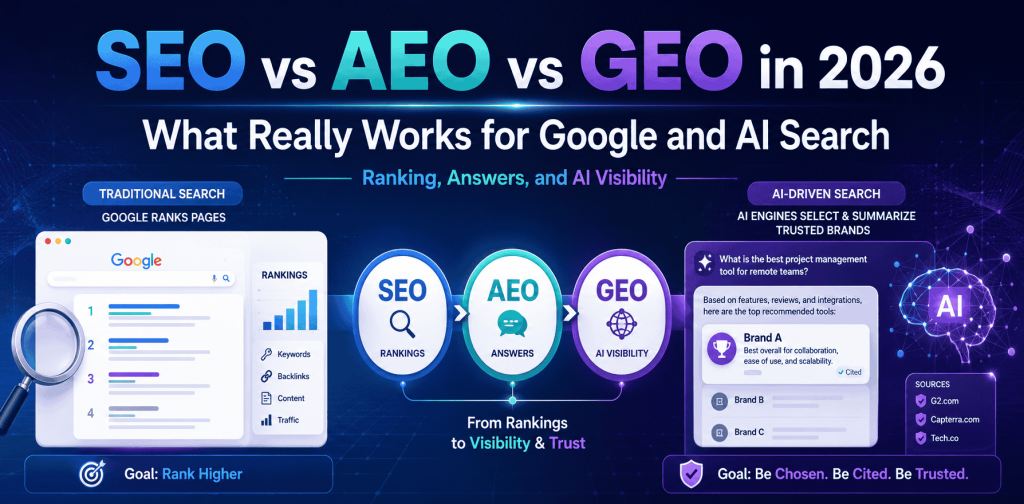
How SEO, AEO, and GEO Work Together in 2026
SEO, AEO, and GEO are three layers of the same visibility system.
SEO, or Search Engine Optimization, helps pages rank in traditional search results through crawlability, technical health, helpful content, topical authority, backlinks, internal links, page experience, and user intent.
AEO, or Answer Engine Optimization, helps content answer direct questions. It targets featured snippets, People Also Ask, voice search, FAQs, and AI-generated summaries.
GEO, or Generative Engine Optimization, helps AI engines understand, trust, and cite your brand when they generate answers. It depends on clear entities, expert signals, original insights, structured information, citations, reviews, and consistent brand mentions.
The smart strategy is simple: use SEO to be discoverable, AEO to be answerable, and GEO to be selectable.
Ranking vs Selection: How Google and AI Engines Choose Content
Traditional SEO is mostly a ranking game. Google crawls pages, evaluates relevance and quality, and arranges results. AI engines behave differently. They retrieve sources, compare them, summarize them, and produce one conversational answer.
That means your page can rank, but still not be selected by AI. Or your brand can appear in AI answers even when the exact page is not number one. Selection depends on clarity, credibility, entity recognition, source consistency, and whether your content gives AI enough confidence.
Thin “SEO articles” are weak because they lack experience, examples, expert commentary, and clear answers.
What Makes Content AEO-Friendly?
AEO-friendly content answers questions quickly, clearly, and completely. It uses natural language because users ask full questions now, not only short keywords.
Instead of only targeting “SEO services Pakistan,” a stronger page answers: “How much do SEO services cost in Pakistan?” “How long does SEO take?” and “Is SEO still worth it if AI answers reduce clicks?”
Good AEO content includes question-based headings, short direct answers, plain definitions, comparison tables, FAQs, step-by-step instructions, and FAQ schema where eligible.
What Makes Content GEO-Friendly?
GEO-friendly content helps AI systems identify who you are, what you know, and why you should be trusted. It needs stronger proof than ordinary SEO writing.
A GEO-friendly page should include author credentials, first-hand experience, named tools, original examples, client outcomes, transparent methodology, expert quotes, and consistent brand details. For service businesses, this means case studies, process pages, pricing explanations, service-area pages, testimonials, and educational resources.
A generic blog post is forgettable. A specific page with proof, numbers, and expert perspective is much more likely to be selected.
Keywords That Trigger AI Overviews
AI Overviews and AI answers are more likely to appear for informational, comparison, problem-solving, and step-by-step queries. Common triggers include “what is,” “how to,” “best,” “compare,” “cost,” and “why” searches.
Examples include “What is AEO in digital marketing?”, “How to optimize content for AI search?”, “SEO vs AEO vs GEO,” and “Why is my website traffic dropping?” These searches need explanation, not just a product page.
Traditional Search Engines Rank Pages, AI Engines Select Brands
This is the biggest shift. Google ranks pages. AI engines often select brands, entities, and sources.
For example, a bakery may rank for “custom cakes Lahore,” but an AI assistant may recommend it only if it sees consistent signals: a complete website, Google Business Profile, reviews, photos, local mentions, pricing clarity, and helpful content about cake sizes, flavors, delivery, and ordering.
In 2026, brand consistency is an SEO asset. Your name, services, location, author profiles, social pages, reviews, and citations must tell the same story.
Which Content Type Works Best for SEO, AEO, and GEO?
| Goal | Best Content Type |
| SEO traffic | Blog posts, service pages, location pages |
| AEO answers | FAQs, how-to guides, comparison articles |
| GEO visibility | Case studies, expert guides, original research |
| Local trust | GBP posts, reviews, local pages |
| Conversion | Pricing pages, testimonials, portfolio pages |
Publishing only blogs is lazy. Publishing only service pages is incomplete. A serious website needs all of these.
Biggest Mistakes Businesses Make with AI Search Optimization
The biggest mistakes are treating GEO as a trick, publishing generic AI-written content, ignoring technical SEO, using inconsistent business details, and measuring only rankings. AI search rewards brands that already look trustworthy. If your article says the same thing as 500 other pages, it gives AI no reason to cite you. If your business details are inconsistent, AI confidence drops.
How to Measure SEO, AEO, and GEO Performance
Measure SEO with Google Search Console clicks, impressions, average position, indexed pages, Core Web Vitals, backlinks, and organic conversions.
Measure AEO by tracking featured snippets, People Also Ask appearances, FAQ rankings, voice-style queries, and question-based impressions.
Measure GEO by monitoring brand mentions in ChatGPT, Gemini, Perplexity, AI Overviews, Bing Copilot, and industry comparison queries. Also track whether AI tools mention your brand with correct services, location, and positioning.
Your monthly dashboard should include top landing pages, question keywords, AI Overview appearances, branded search growth, conversions, reviews, citations, backlinks, and content gaps.
7 Practical Steps to Win SEO, AEO, and GEO in 2026
- Build one core topic cluster. Choose a main topic like “AI SEO services” and support it with pricing, tools, mistakes, case studies, FAQs, and comparisons.
- Answer questions before selling. Every service page should explain cost, timeline, process, results, and expectations.
- Add proof to important pages. Use screenshots, results, client examples, reviews, awards, and before-after comparisons.
- Use structured data. Add Article schema for blogs, FAQ schema where eligible, LocalBusiness schema for local brands, and Organization schema for company details.
- Create entity consistency. Keep your business name, logo, phone, address, social profiles, and service descriptions consistent.
- Write for extraction. Use short definitions, tables, bullet points, summaries, and direct answers.
- Refresh content quarterly. Update statistics, tools, screenshots, examples, and recommendations.
Case Study: How a Local Service Business Could Improve AI Search Visibility
Imagine a Lahore-based repair company with a basic website and weak rankings. It publishes one optimized service page, five question-based blogs, one pricing guide, one comparison article, and one case study showing how it reduced customer response time by 40%.
It also updates its Google Business Profile, requests reviews, adds LocalBusiness schema, and makes brand details consistent across directories.
After four months, organic impressions increase by 65%, branded searches rise by 30%, and three FAQ sections appear for question-based searches. AI tools also describe the company more accurately because clearer evidence now exists online.
The lesson is blunt: AI search does not fix a weak brand. It exposes one.
What Comes After SEO, AEO, and GEO?
The next stage is entity-first marketing. Search engines and AI platforms will care less about isolated keywords and more about trusted brands, expert authors, verified experience, structured data, and real-world reputation.
Businesses that invest in original content, reviews, community trust, and expert-led education will keep winning. Businesses that depend on copied blogs and keyword stuffing will become invisible.
Visual and Content Cluster Recommendations
Add an infographic comparing SEO, AEO, and GEO, a flowchart showing ranking vs selection, and a dashboard screenshot. Link this article to posts on AI SEO tools, local SEO checklists, FAQ content, Google Business Profile optimization, and SEO content audits.
Conclusion
SEO is not dead. It has expanded. In 2026, businesses need SEO for rankings, AEO for direct answers, and GEO for AI recommendations. The winning formula is helpful content, technical clarity, expert proof, strong brand signals, and consistent measurement.
At Digital Media Clicks, we help businesses build search visibility across Google, answer engines, and AI platforms with practical SEO, AEO, and GEO strategies designed for real leads, not vanity traffic.
FAQs
Is SEO still important in 2026?
Yes. SEO is still the foundation because AI engines often depend on crawlable, trustworthy web content.
What is the difference between AEO and GEO?
AEO focuses on direct answers. GEO focuses on being selected, cited, or recommended by generative AI engines.
Can AI-written content rank on Google?
AI-assisted content can perform if it is helpful, accurate, original, and reviewed by experts. Generic mass-produced content is risky.
How long does SEO, AEO, and GEO take?
Most businesses need three to six months, depending on competition, website health, and brand authority.
What schema should I use for this blog?
Use Article schema, Organization schema, Breadcrumb schema, and FAQ schema where the FAQ content is visible and follows Google’s guidelines.
What is the best first step for a small business?
Start with a content audit. Find weak pages, missing FAQs, outdated blogs, poor internal links, and unclear brand information.

Pingback: How to Get Cited in ChatGPT, Gemini & Google AI Overviews