
Introduction
Search is changing faster than ever. Gone are the days when traditional search engine optimization (SEO) was enough to bring in traffic. Today, businesses must also think about AEO (Answer Engine Optimization) and GEO (Geographical Optimization) if they want to stay ahead. These three strategies—SEO, AEO, and GEO—work together but serve different purposes. Understanding their key differences, benefits, and winning tactics will help you build a digital presence that attracts the right audience at the right time.
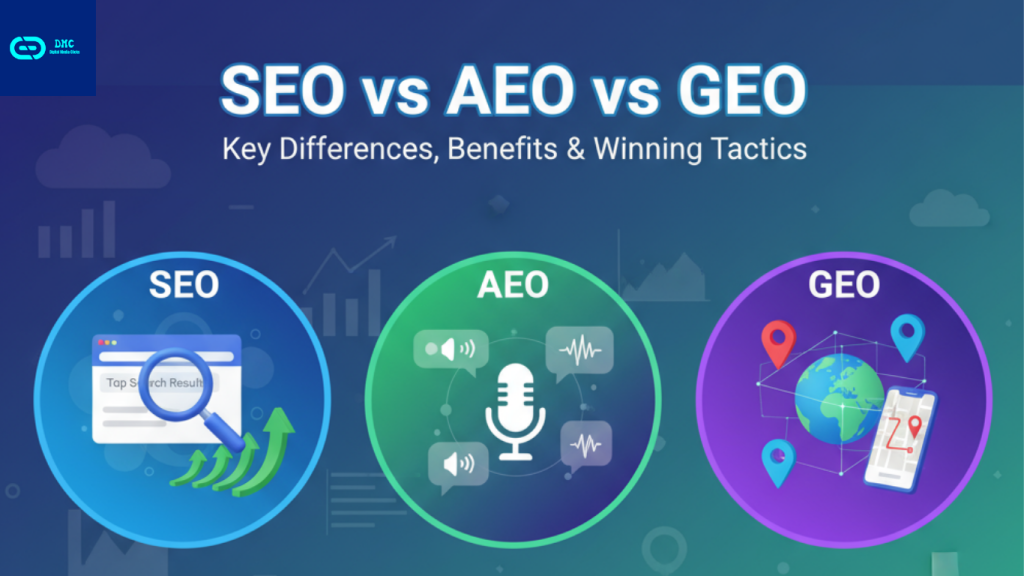
What is SEO?
SEO stands for Search Engine Optimization. It’s the process of improving your website so it appears higher on search engine results pages (SERPs). When people search for products, services, or answers, SEO helps your site show up.
Core Benefits of SEO:
- Increases organic (free) traffic
- Builds trust and credibility
- Improves user experience
- Delivers long-term results
SEO is still the backbone of online marketing. Without it, your business risks staying invisible online.
What is AEO?
AEO means Answer Engine Optimization. Unlike SEO, which targets search engines like Google, AEO focuses on optimizing content for voice assistants and AI-driven tools such as Siri, Alexa, and Google Assistant. These platforms don’t give a list of results—they provide a single, direct answer.
Core Benefits of AEO:
- Boosts visibility in voice searches
- Positions your brand as the “go-to answer”
- Helps reach mobile and smart device users
- Supports conversational queries
For example, instead of typing “best Italian restaurant near me,” users ask, “Where’s the best Italian restaurant close by?” AEO ensures your business pops up as the answer.
What is GEO?
GEO stands for Geographical Optimization, which focuses on making your business visible in local searches. Think of it as local SEO on steroids. It ensures that people searching within your area find your services quickly.
Core Benefits of GEO:
- Drives foot traffic to physical stores
- Targets high-intent local customers
- Improves Google Maps visibility
- Strengthens local brand awareness
For businesses with physical locations—like restaurants, clinics, or retail shops—GEO can be a game-changer.
In this blog, we’ll break down each one in plain language, compare how they work, and share practical tips you can start using today.
SEO vs AEO vs GEO: The Key Differences
| Feature | SEO |
AEO |
GEO |
| Focus | Search engines | Answer engines & voice search | Local and geographical searches |
Goal |
Higher rankings in SERPs |
Direct answers to user queries |
Local visibility & foot traffic |
Users Targeted |
Online searchers | Voice searchers & smart devices |
Local customers |
Main Benefit |
Organic traffic | Quick, conversational results |
Local brand exposure |
While SEO, AEO, and GEO overlap, each one targets different user behaviors. Businesses that combine all three stand out more than those relying on just one.
Winning Tactics for SEO
- Do thorough keyword research
- Optimize on-page elements like titles, headings, and images
- Build high-quality backlinks
- Publish valuable, relevant content
- Improve site speed and mobile-friendliness
SEO is all about long-term authority and trust. The more you align your content with what users need, the more search engines will reward you.
Winning Tactics for AEO
- Focus on conversational keywords (who, what, where, how)
- Create clear, concise content with direct answers
- Use structured data (schema markup)
- Add FAQ sections to your pages
- Optimize for mobile-first indexing
The trick with AEO is making your content “voice-ready.” Short, precise answers win.
Winning Tactics for GEO
- Claim and optimize your Google Business Profile
- Use consistent NAP (Name, Address, Phone) information everywhere
- Collect and respond to customer reviews
- Add location-based keywords in titles and descriptions
- Share localized content to connect with nearby audiences
GEO thrives on accuracy and trust. If your business info is outdated or inconsistent, you’ll lose local customers.
Why You Need All Three
Focusing only on SEO may get you rankings, but what about voice users or local shoppers? AEO makes your brand the answer to spoken queries, while GEO ensures people around you find your services. Together, these three strategies create a complete digital growth system.
Conclusion
The digital world no longer belongs to just SEO. With the rise of smart assistants and local search, AEO and GEO are equally essential. SEO gives you visibility, AEO makes you the answer, and GEO connects you with local customers. Businesses that embrace all three can win more traffic, leads, and customers in today’s competitive market. Ready to optimize your business for SEO, AEO, and GEO? Digital Media Clicks can help you craft strategies that drive real results. Let’s take your brand to the next level
FAQs
1. Is AEO replacing SEO?
No, AEO isn’t replacing SEO. Instead, it complements SEO by targeting voice search and answer engines. SEO builds the foundation, while AEO fine-tunes it for conversational queries.
2. Why is GEO important for small businesses?
GEO is critical because it helps small businesses attract local customers who are ready to buy. Most people search for nearby services before visiting a store.
3. Can I apply SEO, AEO, and GEO at the same time?
Yes! In fact, combining them is the best approach. SEO gives you visibility, AEO ensures voice presence, and GEO boosts local traffic.
4. Do I need technical skills for AEO?
Not necessarily. While structured data helps, you can start with simple steps like writing clear FAQs and using natural language in your content.
5. How long does it take to see results from SEO, AEO, and GEO?
SEO takes a few months to show strong results. AEO can work faster if your content is well-structured. GEO often delivers quicker wins, especially once your Google Business Profile is optimized.